

What Manual Hospital Approvals Really Cost the People Who Deliver Care
Behind every stalled approval form in a hospital is a person waiting. A nurse who cannot start a treatment plan. A patient lying in a bed wondering why nothing is happening. A new physician who still cannot see patients weeks after being hired. A billing clerk re-keying the same request for the third time. Manual approval processes are usually described as a financial problem, but the people who live inside those processes experience them as something more personal: lost hours, mounting frustration, and the quiet erosion of the reason they came to work in healthcare in the first place.
When approvals depend on chasing signatures, forwarding emails, and waiting for someone to be at their desk, the strain spreads across every role in the building. This article looks at manual approvals through the eyes of the people they affect most directly: the nurses, patients, doctors, specialists, and back-office staff who absorb the delays. It then looks at how these problems compound, and how hospital workflow automation through approval tracking systems and standardized approval processes can give those people their time and attention back.
What Manual Approvals Feel Like for the People Who Carry Them
Nurses: Caught Between the Patient and the Paperwork
For a nurse, an approval that sits in someone else’s inbox is rarely an abstraction. It is a wound dressing that cannot be ordered, a medication change that cannot be actioned, or a transfer that cannot move forward until a signature appears. Nurses end up playing detective, phoning one department, faxing another, and walking forms down the hall because no one is sure who is supposed to approve what. Every minute spent tracking down an authorization is a minute taken from the bedside.The cost shows up in the body as much as the schedule. Nurses already shoulder some of the heaviest documentation loads in the hospital, and chasing approvals layers more of it on top. The result is a workforce that feels stretched thin and increasingly removed from the patients they trained to care for, which is one of the most common reasons experienced nurses say they want to leave.
Patients: Waiting on a Process They Cannot See
Patients almost never see the approval queue, but they feel its effects acutely. A delayed prior authorization can mean a surgery postponed, a prescription left unfilled at the pharmacy counter, or a referral to a specialist that stalls for days. For someone who is sick, frightened, or in pain, the explanation that a form is “still waiting for sign-off” lands as something close to abandonment. The teams buried in manual claim management spend so long re-keying and resubmitting requests that the patient’s clock and the paperwork’s clock drift further and further apart. What patients rarely realize is how much of their care team’s attention is pulled away from them and into searching for, reading, and transcribing documents. Time a clinician spends wrestling with documentation is time not spent listening, examining, or explaining. The experience that results is the one patients describe most often as frustrating: feeling like a case number moving through a system rather than a person being cared for. And the longer a patient waits without clear answers, the more anxiety they carry into every interaction that follows ,which makes the next conversation harder for everyone involved.
Doctors and Specialists: Decisions Made, Then Held Hostage
A physician makes a clinical decision in seconds, then watches it sit in limbo for days. For doctors and specialists, manual approvals turn medical judgment into a waiting game governed by whoever happens to be available to sign. A specialist who has reviewed a case and recommended a procedure cannot move until the authorization clears, and when a form comes back rejected over a missing field or a transcription slip, the whole sequence starts again. Hand-keyed paperwork is where these errors creep in, and the errors are not just administrative annoyances ,they are the reason a treatment plan a doctor is confident about gets bounced back. Much of the rework physicians and specialists are dragged into traces to the same root as their claim denials: poor documentation that loops the clinician back into a cycle of correcting, re-justifying, and resubmitting work they had already finished. Every loop chips away at a specialist’s time and at their sense that their expertise is actually being put to use, which is corrosive for the very people a hospital can least afford to burn out.
Back-Office Staff: The People Holding the Whole Thing Together
Credentialing coordinators, schedulers, billing clerks, and procurement staff are the people who actually keep approvals moving, and manual processes make that job thankless. A credentialing coordinator may wait more than a month for a new physician to be cleared to see patients, fielding daily questions from a doctor who is ready to work but cannot, and from managers who want to know why. They are the ones who absorb the blame when a payer approval slips, even though they had no control over where the form was stuck. They are also the ones who notice, too late, when something time-sensitive has quietly gone unattended on someone’s desk. When a contract lapses or an order misses a deadline because a signature never came, it is the back-office team that has to explain the missed opportunity and then clean up the consequences. Most of these people are conscientious and capable; the process simply gives them no way to see where a request stands or to keep it from falling through the cracks.
How These Delays Multiply Across the Hospital
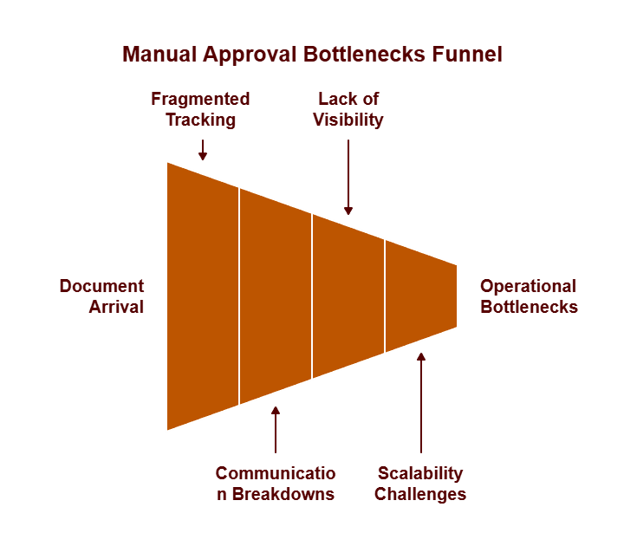
Nobody Is Sure Whose Desk It Belongs On
Approval bottlenecks happen for an entirely human reason: the right person is out, unsure whether the decision is theirs, or already buried under a stack of other manual tasks. A request lands on the wrong desk because no one is certain who is supposed to own it, and instead of a clear path it travels through email chains and hallway handoffs. The people who need the decision are left guessing, the person who could make it may never realize it is waiting, and a contract quietly expires or a new hire sits idle because the one manager who can sign off cannot be found. None of this is anyone’s fault in particular, which is exactly why it keeps happening.
“Did You See My Email?”
When departments coordinate through forwarded emails and chased-down signatures, the gaps between them fill with small, draining frictions. A requester sends a polite nudge, then another, then walks over in person to ask whether anyone saw the message. An approver, meanwhile, only discovers an urgent item after the deadline has already slipped by. Care decisions, supply orders, and onboarding steps all slow to the speed of the slowest inbox, and the people on both ends spend their energy managing the process instead of doing the work the process was meant to support.
No One Can See Where Anything Stands
An approver cannot act on a request they do not know exists, and when requests live in scattered inboxes and shared drives with no alerts, things simply sit. There is no single place where a nurse, a clerk, or a department head can glance and see what is pending, what is stuck, and who is holding it. That blindness reaches all the way up. Leaders who want to help cannot point to the bottleneck, because without a shared view of the work, the bottleneck is invisible until someone downstream feels its consequences.
The Only Fix Becomes “Hire More People”
As a hospital grows, the number of approvals grows with it, and a process that leans entirely on people does not stretch gracefully. The existing staff simply absorb more, until the only apparent answer is to add headcount to keep the paperwork moving. Approval chains that ask for five signatures where two would do turn every routine request into a slow relay, and the people in that relay feel the volume long before any dashboard would show it. Growth that should feel like progress instead feels like falling further behind.
When the Paper Trail Fails the People Who Rely on It
A Missing Form Puts Everyone’s Work at Risk
Meeting Medicare’s Conditions of Participation is what keeps the lights on, and the stakes of falling short have only grown sharper. But the failures that trigger trouble are rarely grand; they are usually a single form that went missing or was never scanned in time. One overlooked piece of paper can break the chain of evidence a surveyor expects to see, and suddenly the careful work of an entire department is in question because of a gap no one intended to leave. The staff who scanned, filed, and tracked those forms by hand carry that anxiety, knowing how easily one slip can undo months of diligence.
Rushed Paperwork, Denied Claims, and More Rework
When people are rushed, mistakes follow. Documentation done in a hurry leaves out a code or records an inaccurate diagnosis, and that small error becomes a denied claim or a Medicare audit. For the billing and coding staff, it means redoing work they thought was finished; for the clinician, it means being pulled back to re-justify a decision; and for the patient, it can mean an unexpected bill or a fresh round of delay. The error rarely reflects carelessness so much as a process that asks people to move faster than careful work allows.
The Disruption Lands on Real Teams
A penalty is never just a line on a budget. When an organization falls out of compliance, the fallout reshapes people’s days: corrective action plans and corporate integrity agreements pull staff off their normal work, add new security steps, and often bring in outside help that the existing team has to accommodate. Even HIPAA fines can disrupt a workforce for months. The people who lived through the original process failure are usually the same ones asked to absorb the cleanup, which is why preventing the failure matters far more to them than any after-the-fact remedy ever could.
How Automation Gives People Their Time Back
Less Chasing, More Caring
When an approval routes itself to the right person automatically, the hours nurses and clerks once spent chasing signatures simply come back to them. A request that used to take fourteen extra minutes of phone tag clears in moments, and that reclaimed time goes where it belongs ,to the bedside, to the patient on the phone, to the work people trained to do. Automation also quietly removes the errors that hand-keying invites, so staff are not pulled back into rework. The change people notice first is not a number on a report; it is that the day stops being a series of small chases.
Everyone Knows Who Decides What
A standardized workflow settles the question that causes so much of the frustration: who is responsible for this decision, and what happens next. Instead of a request depending on whether one particular person happens to be at their desk, the path is clear and consistent across departments, from finance to supply chain to compliance. People stop wondering whether something fell through the cracks because the process itself carries it forward and keeps a record of every step. The relief is real: no one has to hold the whole map in their head anymore.
The Answer to “Who Approved This?” Is Always There
Every action in an automated workflow leaves a timestamped record, so the audit trails a surveyor asks for are already there, complete and in order. The compliance officer who once dreaded that question can now answer it in seconds. Audits move faster, findings drop, and the staff who used to brace for survey season can stop carrying that quiet dread, because the evidence of their good work finally documents itself.
Relief Without Adding to the Payroll
Most hospitals cannot simply hire their way out of an approval backlog, and the people already in place are stretched thin. Automation eases that pressure without adding headcount, because the routine routing and tracking no longer fall on human shoulders. Freed from the busywork, staff can spend their hours on the parts of their jobs that actually require judgment and care. The point is not to replace people; it is to stop wasting them on tasks a system can handle, so the team a hospital already has can finally do the work it was hired to do.
Conclusion
Manual approval processes are usually counted in dollars, but they are lived by people. The nurse who cannot get back to the bedside, the patient waiting on a decision they cannot see, the doctor whose judgment sits in limbo, the specialist redoing finished work, the back-office staff blamed for delays they never caused ,each one absorbs a piece of the same broken process. Hospital workflow automation changes that experience. It gives nurses their time, patients their answers, clinicians their focus, and administrative staff a process they can actually see and trust. The case for it is not really about the money saved; it is about letting the people who chose healthcare spend their days on the reason they chose it.
FAQs
Q1. Who is most affected by manual approval processes in hospitals?
Almost everyone in the building feels them. Nurses lose bedside time chasing authorizations; patients wait on care decisions they cannot see; doctors and specialists watch sound clinical judgments stall in limbo; and back-office staff absorb the blame for delays they did not cause. The strain is cumulative ,each stalled form pulls another person away from the work they trained to do and adds to a shared sense of being stretched too thin.
Q2. How do manual approvals affect day-to-day work across teams?
They turn straightforward tasks into small, draining frictions. Requests land on the wrong desk because no one is sure who owns the decision, so people resort to nudging emails and walking forms down the hall. Approvers often do not realize an urgent item is waiting until the deadline has already slipped. As volume grows, the same handful of people simply absorb more, until everyone feels the backlog long before any report would show it.
Q3. What does the compliance burden feel like for the staff responsible for it?
It is a quiet, constant anxiety. When a surveyor asks how a policy was reviewed and who signed off, a compliance officer relying on scattered email threads is left defending work they know was done properly but cannot prove. A single form that went missing or was never scanned in time can break the evidence chain and put an entire department’s diligence in question. The people who tracked those approvals by hand carry the weight of knowing how easily one slip can undo months of careful work.
Q4. What changes for people when approvals are automated?
The day stops being a series of small chases. Requests route themselves to the right person automatically, so the minutes nurses and clerks once lost to phone tag come back to them and go where they belong ,to patients. Everyone knows who owns each decision and can see where a request stands, so nothing quietly falls through the cracks. And because every step is recorded as it happens, the staff who used to brace for survey season can stop carrying that dread. The real return is people spending their time on the work they actually trained to do.
Q5. Why do manual processes lead to so much rework for clinical and billing staff?
Because the process asks people to move faster than careful work allows. Hand-keying the same details across systems invites small slips ,a missing field, a transcription error, a code left off ,and each one can bounce a claim back or trigger an audit. When that happens, billing and coding staff redo work they thought was finished, and clinicians get pulled back to re-justify decisions they already made. The error rarely reflects carelessness; it reflects a system that buries people in repetitive entry and then penalizes the inevitable mistakes.