Aerospace Software Risks: Why Legacy Systems Are Threatening Your Operations
Aerospace software risks became impossible to ignore when a ransomware attack paralyzed check-in and boarding systems at major European hubs, exposing critical vulnerabilities in aviation infrastructure. The incident highlights a deeper crisis: global technical debt has reached $3.6 trillion, with aerospace firms operating aging COBOL, Fortran, and monolithic C++ systems that few understand. Even worse, over 67% of legacy aerospace systems lack accurate documentation, while military organizations spend up to 75% of IT budgets maintaining outdated aerospace software.
These legacy aerospace systems create operational bottlenecks, compliance gaps, and security vulnerabilities that threaten business continuity. This article examines how outdated aerospace operations software generates hidden costs, escalates aerospace traceability risks, and compromises regulatory readiness, and outlines practical aerospace software modernization strategies to restore operational control.
Key Takeaways
Legacy aerospace systems pose critical operational, financial, and compliance risks that demand immediate attention. Here are the essential insights every aerospace organization needs to understand:
- Legacy systems drain budgets: Organizations spend over $2 million annually maintaining outdated platforms, with costs escalating 12.5% yearly as technical debt accumulates.
- Knowledge dependencies threaten continuity: Over 67% of legacy aerospace systems lack proper documentation, creating single-person dependencies that risk operational collapse when experienced staff inevitably retire.
- Manual workarounds multiply errors: Workers waste 3+ hours daily navigating inefficient systems, while human error contributes to over 50% of aerospace manufacturing mistakes.
- Compliance gaps expose vulnerabilities: Legacy ERP systems deliver accurate data only 30% of the time, undermining AS9100 compliance requirements and audit readiness.
- Phased modernization minimizes disruption: Structured transformation through assessment, integration, and optimization stages enables organizations to modernize without operational shutdown.
The aerospace industry faces a critical inflection point where the cost of inaction exceeds modernization investment. Organizations that implement systematic digital transformation strategies will gain competitive advantages through improved efficiency, enhanced compliance, and reduced operational risk.
The Hidden Costs of Legacy Aerospace Systems
Legacy aerospace systems generate financial burdens that extend far beyond visible line items in IT budgets. Companies spend more than $2 million annually maintaining outdated platforms , with these costs compounding by 12.5% each year as technical debt accumulates . The financial impact becomes catastrophic when hidden expenses remain unaccounted in operational planning.
Aging infrastructure consuming operational budgets
Infrastructure expenses persist regardless of system usage. Organizations continue paying licensing fees for maintenance contracts, user licenses, and third-party software dependencies tied to legacy platforms . Old ERP systems prove particularly expensive, requiring licenses even for read-only access to historical data . Data center space, virtualization resources, storage capacity, and backup systems dedicated to aging aerospace software consume electricity, cooling, and hardware resources . Aviation companies now report legacy IT as a significant roadblock, with 80% identifying outdated systems as operational barriers . System downtime from failed upgrades costs airlines up to $400,000 per hour , while nearly 50% of modernization attempts fail due to poor integration between legacy and modern platforms.
Documentation gaps creating knowledge dependencies
Outdated aerospace software creates knowledge dependencies that threaten operational continuity. Personnel familiar with legacy systems become single points of failure, holding undocumented knowledge that proves difficult to transfer . Older platforms designed before modern CAD tools often exist as files on obsolete media or paper records , making repairs and upgrades nearly impossible. When classified systems lack complete documentation, engineers cannot reverse-engineer components or understand original design intent . As experienced engineers retire, institutional knowledge disappears, causing delays in maintenance and system re-engineering efforts . This knowledge gap compounds labor shortages already impacting the aerospace MRO industry.
Incompatibility with modern aerospace software engineering tools
Legacy aerospace systems were never designed to integrate with modern platforms like AI, IoT, or cloud-based tools . Compatibility issues with current hardware, operating systems, and security tools create technological dependencies on outdated components . Organizations require custom integration work, consuming six full-time developers for API development and maintenance, plus two analysts for data transformation . Integration testing cycles add another $60,000 annually . Data silos prevent information sharing, crippling customer service, operations, and revenue management capabilities.
Escalating maintenance costs year over year
Maintenance expenses accelerate as aerospace software ages. Legacy systems demand three to four times more maintenance hours than modern platforms , with 40% of IT resources dedicated to upkeep compared to the 15% industry average . Aircraft O&M spending increases 1% to 3% for every additional year of age , translating to $80 million to $230 million annual increases for Air Force operations alone.
How Outdated Aerospace Software Creates Operational Bottlenecks
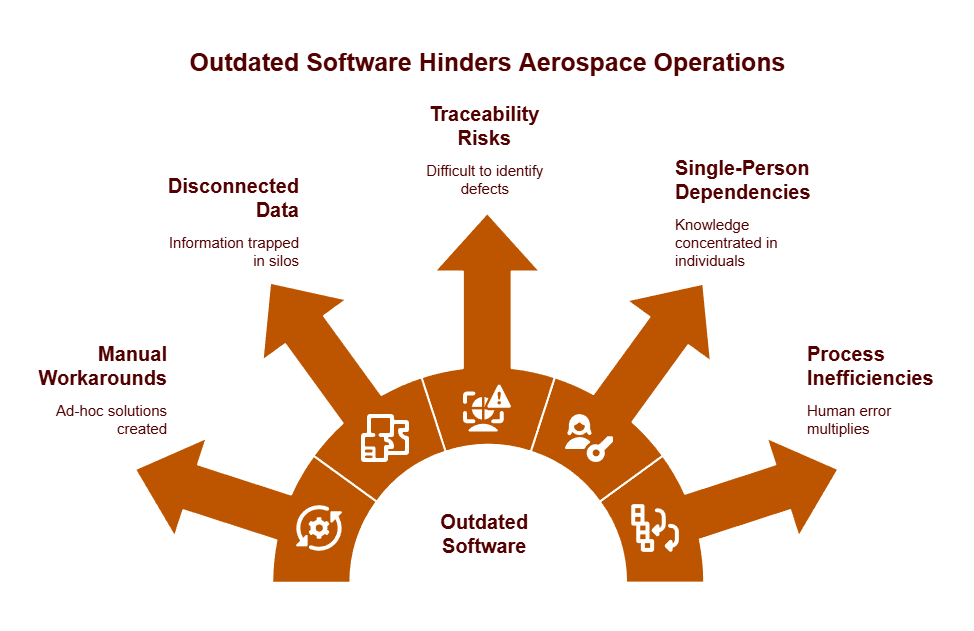
Operational workflows reveal the true cost of outdated aerospace software when teams resort to manual interventions that compound daily. Workers waste three or more hours per day navigating inefficient legacy systems and engineers hired for certification testing spend significant time acting as librarians rather than performing core technical work.
Manual workarounds slowing aerospace operations software
Manual processes designed to bypass system limitations create operational friction across aerospace manufacturing. Teams develop ad-hoc solutions using spreadsheets, emails, and locally created tracking tools simply to maintain production momentum . These workarounds address symptoms rather than root causes, accumulating technical debt that increases system complexity and makes troubleshooting difficult . When something changes in one area, interconnected dependencies cause malfunctions elsewhere . Security protocols weaken as teams disable features to make workarounds function, exposing systems to cyber threats.
Disconnected data systems reducing visibility
Fragmented technology environments trap critical information in isolated databases, spreadsheets, and unsupported software modules . Prior to centralized systems, identifying and isolating faulty parts becomes labor-intensive when records scatter across multiple platforms . Teams depend on outdated reports or email updates to track supplier performance and production timelines rather than accessing real-time data . In detail, disconnected systems prevent several information types from converging simultaneously: machine data, operator activity, product definitions, and material genealogy.
Aerospace traceability risks from siloed information
Traceability management poses major challenges for 63% of aerospace professionals due to siloed tools and fragmented workflows . When defects surface, manufacturers require weeks to identify affected components without centralized digital records . Production halts while engineers manually review batch records . Containment efforts demand significant manpower, escalating operational costs. Manual logs complicate root cause analysis and delay audits.
Single-person dependencies threatening business continuity
Knowledge concentration creates vulnerability when critical system expertise resides with specific individuals. Workarounds implemented quickly lack proper documentation . When employees leave, they take workaround details with them, causing productivity decreases without apparent reason . Organizations lose an average of 23% of specialized mainframe staff over five-year periods, with 63% of positions remaining unfilled.
Process inefficiencies multiplying error rates
Human error contributes to over 50% of all aerospace manufacturing errors . Manual data entry carries a 1-5% error rate, costing $25-30 per mistake . Quality groups wait for overnight reports while flawed parts continue down production lines . Planners approve work based on outdated data because integrations run once daily . These inefficiencies repeat and accumulate, radiating outward until costs become structural.
Why Aerospace Legacy Systems Create Compliance Risks
Regulatory frameworks expose gaps that operational workarounds cannot hide. AS9100 Revision D changed over 95% of compliance standards , yet legacy mainframes with rigid architectures struggle to adapt to these requirements.
AS9100 compliance software integration challenges
Legacy ERP systems deliver correct data only 30% of the time , undermining compliance activities that depend on accurate information. Outdated platforms cannot handle bill of materials traceability or audit trails , forcing manufacturers into manual workarounds prone to human error . AS9100D Clause 8.1.1 mandates structured processes for operational risk management, including assignment of responsibilities and definition of risk assessment criteria . Legacy systems lack the flexibility to implement these requirements across five critical functional areas: Program Management, Sales/Contracts, Design and Development, Purchasing, and Production and Service Provision.
Aerospace audit readiness gaps
Audit preparation becomes an exercise in archeology when evidence scatters across disconnected platforms . Operators struggle during audits not because compliance work wasn’t performed, but because evidence proves difficult to locate, inconsistent in format, or requires manual reconstruction . The absence of rigorous version control leads to loss of design-decision traceability, integration conflicts, and risks of non-compliance with AS9100/ISO 9001 standards . Regulations in aerospace constantly evolve, meaning that documentation needs regular updates to reflect these changes, and outdated documents lead to costly penalties or delays.
Modernizing Aerospace Software: From Risk to Reliability
Transformation strategies seek to replace reactive maintenance with structured modernization pathways. Aerospace Industries Association frameworks emphasize open architecture integration across multiple data forms and vendor tools, requiring alignment with company culture and programmatic goals . One example, Siemens’ five-level maturity model, progresses from document-based workflows to model-based systems (Configure), bridges data across domains (Connect), automates repetitive tasks (Automate), leverages generative design (Generate), and refines through digital twins (Optimize).
Aerospace digital transformation strategy frameworks
Successful transformation requires careful planning and proactive change management across four pillars: IT infrastructure upgrades, digitizing operations, data integration, and organizational alignment . The Aerospace Technology Institute framework addresses integrated supply chains, sector servitization, and digitally-enabled disruption through technology, data analytics, digital mindset, and digital trust capabilities .
Aerospace process automation reducing manual dependencies
Automation frees engineers from tedious tasks, with customers already using rules-based algorithms to auto-generate wiring diagrams, saving thousands of hours per aircraft . Smart automation reduces errors, increases production speeds, and maintains strict quality control.
System integration improving data visibility
Enterprise Product Lifecycle Management centralizes data across engineering, manufacturing, and service domains, enhancing cross-functional collaboration and accelerating time-to-market . Model-Based Systems Engineering enables organizations to design and manage complex systems using digital models, improving collaboration and reducing errors.
Building digital traceability across operations
Digital traceability software enables manufacturers to monitor components from origin to installation, automatically logging machine settings, operator activity, and test results . Barcoding and RFID tags attached to components allow seamless data collection throughout production and assembly.
User-centered redesign for efficiency and control
User-Centered Design approaches blend Human Factors Engineering methods with design thinking, placing emphasis on designing systems around operator capabilities and limitations . Organizations employing UCD report significantly higher situation awareness, lower workload, and higher subjective usability compared to legacy interfaces.
Phased modernization approaches minimizing disruption
Holistic transformation aligns people, processes, technology, and data through three stages: Assessment and Identification, Holistic Modernization and Integration, and Optimization and Continuous Improvement . Visual reverse engineering records real user workflows, reducing documentation windows from 40 hours per screen to 4 hours, then generates API contracts, end-to-end tests, and documented React components.
Conclusion
Legacy aerospace systems present documented threats to operational continuity, compliance readiness, and financial stability. Due to escalating technical debt and regulatory pressure, waiting creates compounding risks that erode competitive positioning. Structured modernization approaches offer practical pathways from reactive maintenance to proactive control.
Organizations that assess infrastructure gaps, implement phased transformation strategies, and prioritize digital traceability will restore operational efficiency while reducing vulnerability. The path forward requires technical precision, experienced partnership, and commitment to systematic improvement rather than temporary fixes.
As aerospace operations grow more complex, outdated systems become harder to justify. Organizations that modernize critical workflows can reduce operational risk, strengthen compliance, and improve process reliability across the enterprise. If your current systems are creating bottlenecks or limiting performance, CyberMedics can help you evaluate opportunities for a more effective and scalable software approach.